
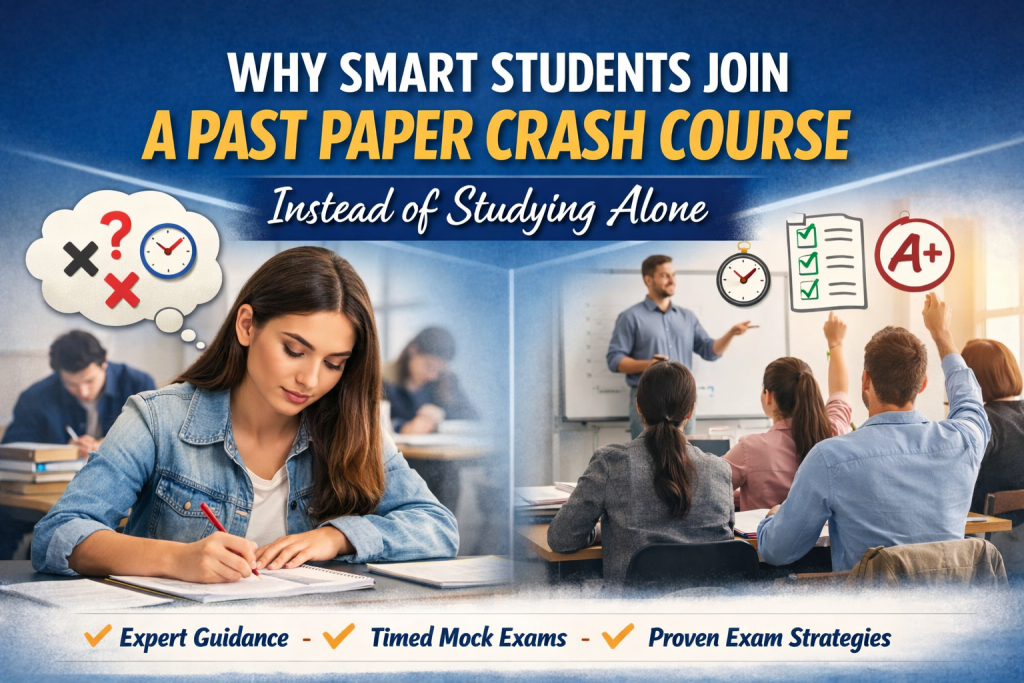
Introduction
Preparing for Cambridge O Levels and A Levels is not just about studying harder it’s about studying strategically. Every year, students spend months revising textbooks, highlighting notes, and solving past papers independently. Yet when results are released, many fall short of their target grades.
The issue is rarely effort.
The real issue is the absence of a structured exam strategy.
Cambridge examinations reward precision, examiner alignment, and performance under pressure not just subject knowledge. That is why high achieving students increasingly enroll in a Past Paper Crash Course instead of relying entirely on self study.
In this article, you’ll learn:
- Why self study often plateaus
- How a structured O/A Levels Past Paper Crash Course improves grades faster
- Who benefits most from joining one
- How Torus Academy helps students maximize marks efficiently
The Myth More Past Papers = Higher Grades
Solving past papers is essential. But solving them randomly is not a strategy.
Many students searching for how to improve O Level grades fast or how to get A in A Levels* assume that volume equals results. In reality, without structured analysis, students repeat the same mistakes.
Common Self Study Mistakes
- Attempting papers without strict timing
- Checking answers without reviewing the official marking scheme
- Ignoring command words such as analyze, evaluate, and discuss
- Repeating structural errors in long answers
- Spending time on low weightage topics while ignoring high frequency questions
Without expert feedback, improvement becomes slow and inconsistent.
What Is an O/A Levels Past Paper Crash Course?
A Past Paper Crash Course is an intensive, exam focused training program designed for students preparing for upcoming Cambridge exams.
Unlike traditional tuition, it does not reteach the full syllabus. Instead, it focuses on performance optimization through:
- Timed past paper practice
- Detailed Cambridge marking scheme analysis
- Command word mastery
- Systematic error correction
- Grade upgrading strategies
The goal is simple: maximize marks in every paper.
Why Studying Alone Often Leads to a Performance Plateau
1. Limited Professional Feedback
Answer keys show what is correct. They do not explain:
- Why marks were lost
- How answers should be structured
- How examiner language influences grading
Structured feedback closes that gap.
2. Weak Marking Scheme Application
Cambridge exams follow precise assessment objectives.
For example:
- O Level Mathematics awards method marks even if the final answer is incorrect
- Science subjects require exact keywords for definitions
- A Level essays are graded in bands based on analytical depth and evaluation quality
Students who do not train using official marking schemes consistently lose easy marks.
3. Poor Time Management Skills
Time pressure reduces performance.
A structured crash course trains students to:
- Allocate time per mark
- Prioritize high value questions
- Maintain speed without sacrificing accuracy
This builds exam stamina and confidence.
4. Repeating the Same Errors
Without structured tracking, students often repeat:
- Calculation mistakes
- Weak evaluation conclusions
- Missing keywords
- Poor paragraph structure in long responses
A crash course introduces systematic mistake analysis to eliminate recurring weaknesses.
How a Past Paper Crash Course Improves Grades Faster
1. Pattern Recognition and Question Trends
Examiners frequently repeat question structures and topic weightage patterns. A strategic program highlights:
- Frequently tested chapters
- Predictable question formats
- Common examiner traps
Instead of solving 20 papers blindly, students learn how to analyze exam trends intelligently.
2. Command Word Mastery
Understanding command words is essential, especially for A Levels:
- Explain → Provide logical reasoning
- Analyze → Break down causes and effects
- Evaluate → Present balanced arguments with a justified conclusion
This alignment with examiner expectations significantly improves scoring.
3. Real Exam Simulation
Structured mock exams replicate real conditions:
- Strict timing
- Exam style seating
- Immediate marking and feedback
Repeated simulation reduces anxiety and improves performance consistency.
4. Targeted Grade Upgrading Techniques
Students stuck at C or B grades typically need refinement, not re teaching.
Crash programs focus on:
- Sharper answer structuring
- Stronger evaluation depth
- Improved clarity and precision
Even an additional 3–5 marks per paper can shift overall grade boundaries.
Self Study vs Crash Course: A Strategic Comparison
| Factor | Studying Alone | Past Paper Crash Course |
| Feedback | Limited | Expert reviewed |
| Time Management | Inconsistent | Structured drills |
| Marking Scheme Mastery | Basic | Advanced |
| Error Tracking | Informal | Systematic |
| Exam Simulation | Rare | Frequent |
| Performance Monitoring | None | Continuous |
Self study builds familiarity.
Crash courses build exam mastery.
Who Should Join a Past Paper Crash Course?
A structured O Level crash course or A Level crash course is ideal for:
- Students 1–2 months before exams
- Students scoring C or D in mock exams
- Students targeting A or A* grades
- Private candidates without structured feedback
If your grades are not improving despite effort, strategy may be the missing link.
Why Students Trust Torus Academy
At Torus Academy, our O/A Levels Past Paper Crash Course is built around Cambridge examiner standards and real marking scheme breakdowns.
We focus on:
- Small batch interactive sessions
- Examiner focused marking scheme training
- Weekly performance tracking
- Structured mistake correction systems
- Exam condition mock assessments
Our objective is clear: help students maximize marks and enter the exam hall with clarity, confidence, and control.
Ready to Upgrade Your Exam Strategy?
If you want to:
- Improve O Level grades quickly
- Strengthen A Level exam technique
- Master Cambridge marking schemes
- Build confidence before your exams
Now is the time to act.
Seats are limited before each exam session secure your place and start preparing the smart way.