
Introduction
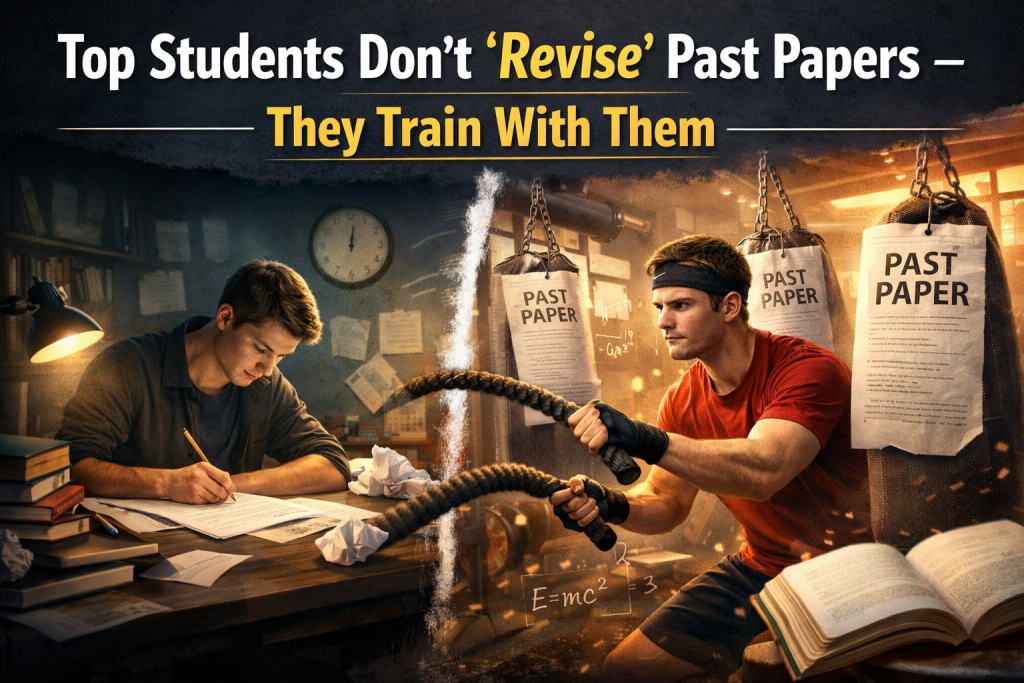
Many students spend hours revising past papers, yet their grades don’t always reflect the effort. The problem isn’t lack of hard work it’s how they use past papers. Simply solving questions and checking answers is revision, but top students take it a step further they train.
Training with past papers means practicing under exam conditions, analysing mistakes, and improving weak areas immediately. It’s an active, structured approach that builds confidence, speed, and exam technique the exact skills Cambridge exams reward.
In this guide, you’ll learn the real difference between revising and training, why most students fail to get the most from past papers, and step by step strategies to turn past papers into a powerful tool for top O/A Level grades.
Revising vs Training: Understanding the Difference
Revision is passive. You answer questions without pressure, skip timing, and move on once it feels “done.”
Training, on the other hand, is active and exam focused:
- Solve past papers under timed conditions
- Analyse mistakes using marking schemes
- Immediately fix weak areas
Cambridge exams reward application, structured answers, and exam technique, not just knowledge. Students who train with past papers consistently outperform those who only revise.
How Top Students Actually Use Past Papers
Top students treat past papers like practice matches, not homework. Their approach includes:
- Starting early and using papers weekly
- Attempting papers under strict timed conditions
- Reviewing marking schemes to see how examiners award marks
They record mistakes, identify patterns, and revise weak topics immediately. This **cycle attempt, analyse, improve, repeat **turns past papers into a training system.
Result: Students develop speed, accuracy, and confidence, which directly translates into higher O/A Level grades.
Why Most Students Waste Past Papers
Many students attempt past papers in the wrong way:
- Casual attempts with no timing
- Quick answer checks without analysis
- Memorising answers instead of understanding marking logic
This creates false confidence. In the actual exam, unfamiliar wording and time pressure can cause panic. Past papers only work when used intentionally with analysis, reflection, and correction.
The “Training” Mindset That Separates Toppers
Top students see past papers as training sessions, not tests. Just like athletes prepare for a match, they:
- Time every paper strictly
- Treat every question seriously
- Treat mistakes as feedback, not failure
- Ask, “How would an examiner award marks here?” instead of “Did I get this right?”
This mindset shifts focus from marks to mastery, helping students build confidence, speed, and precision skills Cambridge exams reward.
Step by Step Guide: Training With Past Papers the Right Way
To train effectively:
- Simulate exam conditions – Time yourself to apply real pressure
- Start topic wise – Focus on weak areas first, then full papers
- Analyse mistakes – Use marking schemes to understand lost marks
- Identify patterns – Track repeated questions and examiner expectations
- Re attempt problem areas – Practice until mastery is achieved
- Track progress – Monitor speed, accuracy, and confidence
Outcome: Past papers become a powerful tool for exam readiness, not just a revision exercise.
Common Mistakes Students Make With Past Papers
Avoid these pitfalls:
- Treating past papers as casual practice
- Skipping mistake review
- Practicing randomly, ignoring weak topics
- Repeating papers without analysis
- Relying on memory instead of conceptual understanding
Correcting these habits ensures past papers boost accuracy, mastery, and exam confidence.
Tips to Maximise Your Past Paper Training
To get the most out of past papers:
- Practice regularly: Integrate papers into weekly routines
- Simulate exam conditions: Build speed and resilience under pressure
- Analyse mistakes carefully: Avoid repeating errors
- Focus on weak areas: Prioritise high weight and challenging topics
- Track progress: Measure improvement and adapt study strategies
Pro Tip: Combine past papers with active concept revision for maximum results.
How Torus Academy Supports Past Paper Training
At Torus Academy, students turn past papers into strategic training tools:
- Expert guidance: Cambridge trained teachers teach exam focused strategies
- Structured programs: Regular past paper sessions with detailed feedback
- Targeted mentoring: Weak areas are addressed individually
- Concept clarity + training: Ensures mastery, confidence, and high accuracy
Result: Torus Academy students consistently achieve top O/A Level results by combining smart training with expert mentoring.
Actionable Steps to Train Effectively With Past Papers
- Practice regularly: Weekly integration ensures consistent progress
- Simulate exam conditions: Build speed and resilience
- Analyse mistakes: Understand lost marks to avoid repeating errors
- Focus on weak areas: Address high weight and challenging topics first
- Track progress: Measure improvement and adapt study strategies
Following these steps turns past papers into training exercises, not just revision tools.
Conclusion
Top students know that past papers are training tools, not last minute revision exercises. By practicing regularly, simulating exam conditions, analysing mistakes, and focusing on weak areas, students develop confidence, accuracy, and mastery over the syllabus.
Hard work alone isn’t enough smart, targeted preparation separates average results from top grades.
Start training with past papers today! Explore Torus Academy’s structured programs for expert guidance, personalised mentoring, and proven exam strategies that transform effort into results.
FAQs – Quick Answers
1. Do past papers help with revision?
Yes. When used actively, they improve exam technique, speed, and confidence.
2. Are past papers worth it?
Absolutely. They show exam patterns, question trends, and marking schemes.
3. Does marking past papers count as revision?
Yes, if you analyse mistakes and understand marking logic, not just check answers.
4. How to use past papers for revision?
Time yourself, review mistakes, reattempt weak areas, and track progress.
5. How can I focus 100% on study?
Eliminate distractions, follow a study schedule, set clear goals, and use short focused sessions.
6. Is 75% an A in A Level?
Yes. Generally, 70–79% corresponds to an A, but aiming higher can reach A*.
7. What is the 2/3/5:7 revision rule?
It’s a spaced repetition strategy: review material after 2h, 3h, 5h, then 7 days to improve memory.
8. Students don’t ‘revise’ past papers – why is training different?
Training uses papers as timed practice with mistake analysis, building mastery and confidence.